Thursday, 21 December 2023

New Thematic Factsheet on Reproductive Rights

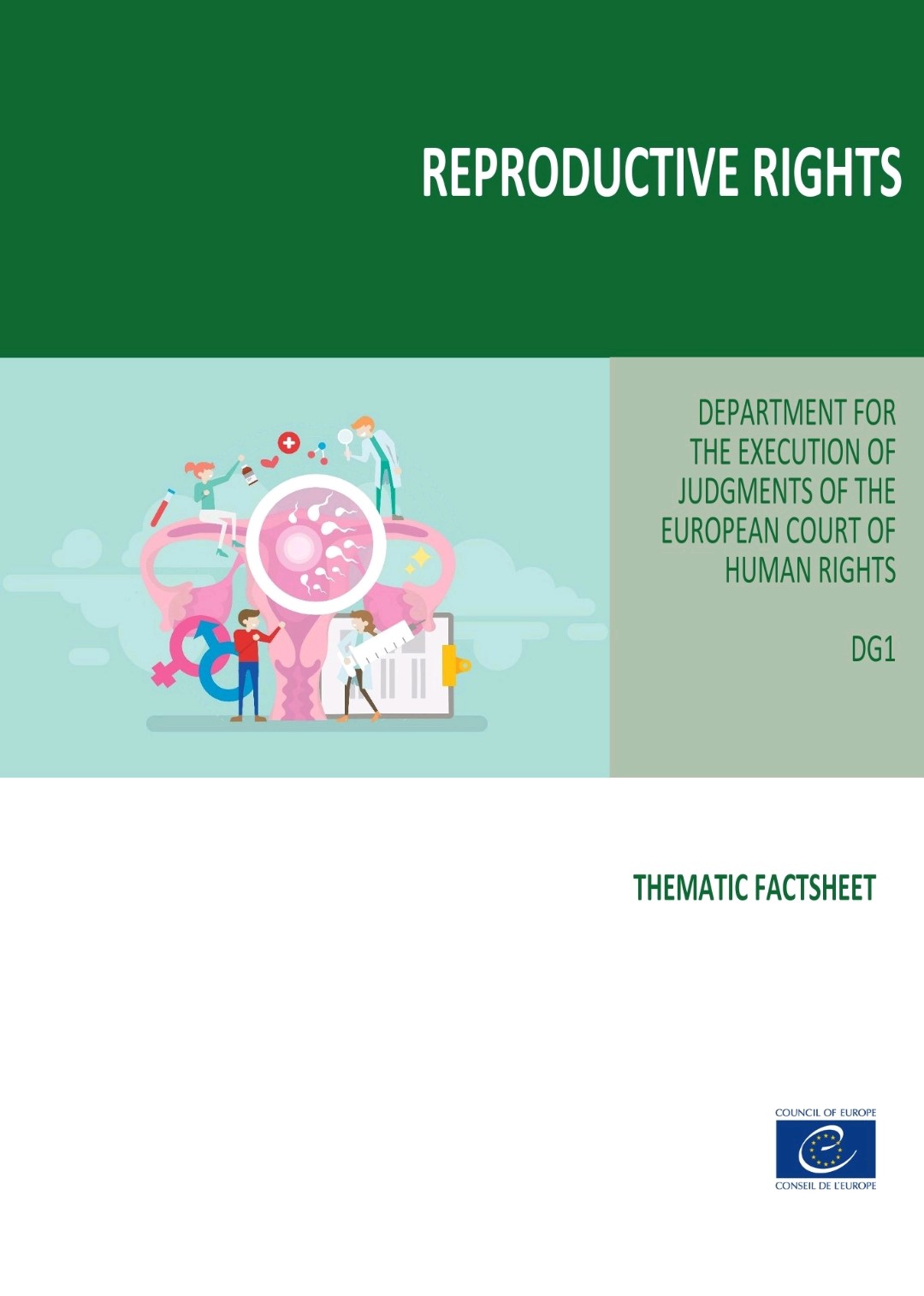
The Council of Europe's Department for the Execution of Judgments of the European Court of Human Rights has just issued a new thematic factsheet on how judgments of the Court have helped to protect and advance reproductive rights. 

Here is a brief description:

'Under the European Court’s case law, the notion of “private life” within the meaning of Article 8 (right to respect for private and family life) of the European Convention on Human Rights incorporates the right to respect for both the decisions to become and not to become a parent. Thus, the European Court addresses under Article 8 issues related to the protection of reproductive rights, such as prenatal medical tests, medically assisted procreation, access to abortion, sterilisation procedures and protection of medical data. In some cases, the Court also examined issues related to the protection of reproductive rights under other Articles, such as Article 3 (the prohibition of torture or inhuman or degrading treatment or punishment), Article 6 (regarding the right of access to a court), Article 10 (freedom of expression), Article 14 (prohibition of discrimination), or Article 1 Protocol No. 1 (protection of property).

Under the European Court’s case law, the notion of “private life” within the meaning of Article 8 (right to respect for private and family life) of the European Convention on Human Rights incorporates the right to respect for both the decisions to become and not to become a parent. Thus, the European Court addresses under Article 8 issues related to the protection of reproductive rights, such as prenatal medical tests, medically assisted procreation, access to abortion, sterilisation procedures and protection of medical data. In some cases, the Court also examined issues related to the protection of reproductive rights under other Articles, such as Article 3 (the prohibition of torture or inhuman or degrading treatment or punishment), Article 6 (regarding the right of access to a court), Article 10 (freedom of expression), Article 14 (prohibition of discrimination), or Article 1 Protocol No. 1 (protection of property).

The present factsheet provides examples of general and individual measures reported by States in the context of the execution of the European Court’s judgments, concerning the: protection of mothers against discrimination, access to medically assisted procreation, regulation of home births, recognition of parent-child relationship in cases of surrogate motherhood, access to lawful abortion and to information on abortion, non-consented sterilisation, protection of personal data and access to medical records, and other issues.'

Wednesday, 20 December 2023

New ECHR Readings


In the last batch of readings of 2023 related to the European Convention on Human Rights and its Court, please find our selection below. We wish all our readers a good holiday season!

* Helen Keller and Viktoriya Gurash, ‘Expanding NGOs’ standing: climate justice through access to the European Court of Human Rights’ Journal of Human Rights and the Environment (2023), vol. 14, no. 2, p. 194-218:


‘Due to the nature of environmental litigation, expanding the standing of actors that could bring claims to the European Court of Human Rights (ECtHR) – such as non-governmental organizations (NGOs) – has become a pressing need. This article explores the current approach to NGOs’ standing to bring environment-related claims before the ECtHR. In particular, by drawing on the Aarhus Convention, the article explores NGOs’ important role before the ECtHR given their recognized right to environmental information, as well as their role in upholding the right to a fair trial at national level. In conclusion, it is argued that NGOs should be given a more prominent role in environmental cases and that the dichotomy between the case law regarding NGOs’ standing in claims under Articles 2, 3 and 8 on the one hand, and Articles 6 and 10 on the other, is outdated.’


* Helga Molbæk-Steensig and Alexandre Quemy ‘Judicial Independence and Impartiality: Tenure Changes at the European Court of Human Rights’, European Journal of International Law (2023), vol. 34, no. 3:


‘Judges should be impartial and independent, judging based solely on the law. Current constitutional literature suggests an important factor in securing this may be the length of tenure. The assumption is that judges with non-renewable terms are more independent than judges with renewable terms since they do not have to worry about reappointment, but proving this assumption empirically is not straightforward. Obstacles include difficulties in comparing different courts and the fact that there is often no obvious case outcome that proves independence. This article aims to overcome these obstacles with a mixed-methods study on the European Court of Human Rights during a time when the tenure rules changed. The study goes beyond the counting of votes and analyses the arguments used in separate opinions as indicators of independence. Our main findings are that, after the introduction of non-renewable terms, judges write more opinions overall, and more of them criticize the judges’ appointing states, while fewer defend it. We also find that judges on non-renewable terms are on average more likely to write opinions addressing violations as systemic problems and to use their opinions to provide guidance for their appointing states on implementing judgments and improving human rights protection.’


* Patrick Leisure, ‘Europe's Schoolhouse Gate? Strasbourg, Schools, and the European Convention on Human Rights’, Stanford Journal of International Law (2023), vol. 59, no. 2: 


‘Yale law professor Justin Driver's 2018 book, The Schoolhouse Gate, argues that American public schools have served as the most important sites of constitutional conflict in United States history. This Article, inspired by Driver's work, argues that primary and secondary schools similarly serve as some of the most significant forums of human rights conflict in the Council of Europe. In support of this argument, the Article adopts a two-tiered analysis. The first is court-centric, focusing primarily on the jurisprudence of the European Court of Human Rights involving schools. The second is society-centric and homes in on the crossroads at which the European Court of Human Rights, schools across the Council of Europe, and European societies meet. By making the above claim regarding the centrality of schools, this Article hopes not only to spur on further discussion about human rights within Europe's schoolhouse gate, but also to deepen the conversation regarding how schools as institutions interact with European supranational human rights protections.’


* Cosette D Creamer and Zuzanna Godzimirska, ‘Trust, Legal Elites, and the European Court of Human Rights’, Human Rights Quarterly (2023), Vol. 45, no. 4:


‘This article interrogates institutional sources of trust distinct to the European Court of Human Rights (ECtHR). Drawing from interviews with ECtHR officials and legal elites, the article identifies practices related to access, procedure, and performance that are central to direct stakeholders' evaluations of judicial trustworthiness. Elite trust is necessary for the continued operation of judicial bodies, and these stakeholders act as intermediaries with the potential to shape public perceptions. The article's findings have important implications for ECtHR's continued relevance, especially given the mounting resistance to it in recent years.’


* Ottavio Quirico, ‘Sources of EU Law: A Review in Light of the Accession of the Union to the ECHR - A Matter of Principle’, Hungarian Yearbook of International Law and European Law (2023):


‘The accession of the EU to the ECHR raises several problems. This article argues that procedural problems are fundamentally rooted in substantive issues, with specific regard to the sources of EU law. More precisely, in order to allow accession, it would be essential to review Article 6(3) TEU so as to lower the level of the ECHR as a source of general principles of EU law to (at least) the same hierarchical level as the founding treaties. Yet, while this solution can be satisfactory for EU Member States that are parties to the ECHR and its protocols, it is not necessarily appealing to non-EU States that are parties to the ECHR system, similar to the stall generated by the Energy Charter Treaty in the field of investment. Furthermore, the solution fundamentally clashes with the consolidated priority of the general principles of EU law crystallized in cases such as Kadi.’


* Sergio Salinas Alcega, ‘The Invasion of Ukraine from the Point of View of the European Court of Human Rights: Extraterritorial Responsibility of Russia and (Un)Control of International Humanitarian Law’, Revue Québécoise de Droit International (2023):


‘The negative impact of the invasion of Ukraine by Russia on international law has many dimensions, the massive and flagrant violation of human rights being one of the most relevant. From this perspective, the role of international mechanisms for the protection of these rights, and notably the European Convention system and the European Court of Human Rights (ECtHR), has become particularly important. The Strasbourg Court’s approach can be divided into two different aspects, which are obviously interrelated. The main aspect relates to the scope of the European Convention on Human Rights’ (ECHR) responsibility regarding Russia. Considering that relevant acts are committed by Russia outside its territory, the question of the extraterritorial application of the Convention becomes crucial. The second aspect relates to how the Strasbourg judges see the interplay between the ECHR and international humanitarian law, and especially their role in exercising a certain amount of control over the latter’s application. Here, the Court could help remedy the shortcomings that currently exist in terms of the availability of specific mechanisms to demand responsibility from the States for the violation of norms in this domain of international law. Regarding both aspects, there is already a rich and developing Strasbourg jurisprudence even if, of course, it is not exempt from criticism. The acts committed by Russia in Ukraine may make it possible to revisit this jurisprudence and allow it to overcome certain shortcomings which have been identified.’


* Aikaterini Tsampi, ‘Islandness and the European Court of Human Rights: Marooning Rights on Islands?’, Netherlands International Law Review (2023), vol. 70 no. 2:


‘Some 80 million people live on European islands. It thus comes as no surprise that a number of cases brought before the European Court of Human Rights developed on and/or pertain to islands. What is surprising, though, is that this jurisprudential corpus has not been explored with a view to assessing whether islandness has or should have a role in the implementation of the European Convention on Human Rights on islands. The present paper contemplates the strengths of an islandness-based approach in the implementation of human rights through the mapping of the weaknesses, the potentials and the lost opportunities in the case law of the Court with respect to such an approach. In this context, findings from the field of Island Studies are also considered. By focusing on the ECHR habitat, the present paper exemplifies, in particular, the untapped potential of an islandness-based approach in the development of international human rights law in general.’

Tuesday, 19 December 2023

New Book on Compliance with ECtHR Judgments

Ramute Remezaite (European Human Rights Advocacy Centre, School of Law, Middlesex University) has just published a new book entitled Compliance with Judgments of the European Court of Human Rights: States on a Spectrum of Democratisation. This is the abstract:

'What does compliance with judgments of the European Court of Human Rights (ECtHR) look like in states on the spectrum of democratisation? This work provides an in-depth investigation of three such states—Armenia, Azerbaijan and Georgia— in the wider context of the growing 'implementation crisis' in Europe, and does so through a combined lens of theoretical insights and rich empirical data.

The book offers a detailed analysis of the domestic contexts varying from democratising to increasingly authoritarian tendencies, which shape the states’ compliance behaviour, and discusses why and how such states comply with human rights judgments. It puts particular focus on ‘contested’ compliance as a new form of compliance behaviour involving states’ acting in ‘bad faith’ and argues for a revival of the concept of partial compliance. The wider impact that ECtHR judgments have in states on the spectrum of democratisation is also explored.'

Friday, 15 December 2023

New Book on the ECHR and the Western Balkans

Venera Kabashi (University of Zurich) has just published her dissertation entitled The ECHR and the Western Balkans: Bringing the Convention Home. The book is published by EIZ (Europa Institut an der Universität Zürich) Publishing and is available as an open access book. The dissertation analyses the impact and the effects of the Convention and the case-law of the Court in Albania, Bosnia and Herzegovina, Kosovo, Montenegro, North Macedonia and Serbia. 

This is the abstract:

'What does it ultimately take to bring the ECHR home in all Western Balkans States and embed it properly within these domestic legal orders? This is the main query of this PhD thesis. How have the domestic courts and other domestic authorities reacted following violations found at the Strasbourg level in respect of their State? How often do the highest domestic courts in the Western Balkans engage in Convention talk and what is the quality of such judicial dialogue? What are the roles of the ECtHR and of the domestic courts in view of their shared responsibility to secure and ensure effective protection of Convention rights? When can the Strasbourg Court comfortably defer to the ratio decidendi of the domestic courts and other domestic authorities? What has been the impact and effects of the Convention and the ECtHR’s case-law in Albania, Bosnia and Herzegovina, Montenegro, Kosovo, North Macedonia, and Serbia? What are the good and not so good ECHR embeddedness practices that may be noticed across the Western Balkan States and what are the recommendations that this study suggests with a view to achieve better embeddedness/domestication of the ECHR? These are only some of the remaining research questions that are explored in this PhD monograph.'

Wednesday, 6 December 2023

Call for Contributions: European Yearbook on Human Rights 2024

The European Yearbook on Human Rights has issued a call for contributions for its 2024 issue. The Yearbook publishes mostly about the European Convention on Human Rights and the Council of Europe. It also contains sections on human rights in the European Union, the Organisation for Security and Co-operation in Europe as well as cross-cutting analysis and commentary.

Here is the description of the call:

'The European Yearbook on Human Rights is shedding light on current human rights topics of concern and the most pressing issues that impair human rights protection, the rule of law and democracy in Europe and beyond. With special sections dedicated to the three main organisations securing human rights in Europe (EU, Council of Europe and OSCE) as well as a section on cross-cutting issues the Yearbook provides muchneeded analysis and insightful commentary. 

The Yearbook is edited by Philip Czech (Austrian Institute for Human Rights, University of Salzburg), Lisa Heschl and Gerd Oberleitner (both European Training and Research Centre for Human Rights and Democracy, University of Graz), Karin Lukas (Department of Legal Studies, Central European University) and Manfred Nowak (Global Campus of Human Rights). It is published by Intersentia and all contributions are subject to a double-blind review process ensuring the highest academic standards. 

We welcome submissions concerning human rights developments within the major European institutions namely the EU, the CoE and the OSCE. Articles concerning a topic not related to one of the aforementioned institutions but dealing with current and topical human rights developments will be taken into consideration as well. 

Authors will be invited to submit full contributions based on an abstract (max 500 words) that should be send by 20 December 2023. Abstracts should be submitted with a short bio to lisa.heschl@uni-graz.at. 

The deadline for submitting the manuscript is end of March 2024.

For further information on the European Yearbook on Human Rights see https://www.larcier-intersentia.com/en/european-yearbook-human-rights-2023-9781839704161.html'

Tuesday, 5 December 2023

Lecture: 'Why the European Convention on Human Rights still matters'

On Thursday 30 November 2023, the President of the ECtHR Síofra O’Leary delivered the annual Mackenzie Stuart Lecture for Cambridge University's Centre for European Legal Studies on 'Why the European Convention on Human Rights still matters'. In the lecture President O'Leary discusses the relationship between the United Kingdom and the Convention, the role of the Convention as an instrument of peace and stability in Europe, the right to access to justice, the rule of law and the continued importance of the Convention in Europe and beyond. 

A recording of the lecture can be found here

Friday, 1 December 2023

NNHRR Interview on Climate Change Litigation before the ECtHR

Last week, Anmol Gulecha (Tilburg University) and Jolein Holtz (Leiden University) gave an interview to the Netherlands Network for Human Rights Research (NNHRR) on the case of Duarte Agostinho and Others v. Portugal and 32 Others, one of the three climate change cases currently pending before the Grand Chamber of the European Court of Human Rights. This case concerns the greenhouse gas emissions from 33 Member States of the Council of Europe. According to the applicants in the case, these emissions contribute to global warming and lead to heatwaves, affecting the applicants' health and living conditions. The interview provides some interesting comments on the case.

The interview is the first episode of the NNHRR #HumanRightsNow interview series which discusses current issues in International and European Human Rights Law. 


Friday, 24 November 2023

New Book on the Freedom of Religion or Belief in the ECHR

Caroline K. Roberts (Oxford Brookes University) has just published a new book entitled Freedom of Religion or Belief in the European Convention on Human Rights: A Reappraisal. This is the abstract:

''The right to freedom of thought, conscience and religion in Article 9 of the European Convention on Human Rights (ECHR) has become increasingly significant and contested. Through an examination of ECHR Article 9, its drafting history, and the related jurisprudence of the European Court of Human Rights (ECtHR), Caroline K. Roberts challenges the classic approach to this right in the literature. Roberts argues that claims that there is, or should be, a clear binary and hierarchical distinction between the absolutely protected internal realm and the qualified external realm in this right are not founded textually or jurisprudentially. Rather, the primary materials suggest that the internal and external aspects are deeply interrelated, and this is reflected in the ECtHR's nuanced and holistic approach to ECHR Article 9 protection. This comprehensive, rigorous and up-to-date reappraisal of ECHR Article 9 and the related ECtHR jurisprudence will be essential reading for academics and practitioners.''

Monday, 20 November 2023

Launch of the Open Council of Europe Academic Networks Project

The Council of Europe has launched the Open Council of Europe Academic Networks (OCEAN) project. The aim of the initiative is to strengthen co-operation between the Council of Europe and European universities and research institutions, and to promote the Council of Europe convention system through sharing and creating knowledge. OCEAN membership is open to universities as well as individual academics teaching at these institutions or conducting research independently. Membership is also open to research institutions (independent or as part of a university), university faculties and existing national and European academic networks working on issues related to Council of Europe conventions. 

This is a summary of the project:

'The Open Council of Europe Academic Networks (OCEAN) unite universities, research institutions and scholars from the Council of Europe´s 46 member states around the shared goal of human rights, democracy, and the rule of law.

Initiated in 2018 by Prof. Michele Nicoletti, then president of the Council of Europe Parliamentary Assembly, OCEAN is now ready to welcome academic members, institutional and individual, to join.

The Open Council of Europe Academic Networks aim at sharing and creating knowledge around the Council of Europe´s more than 200 conventions in European academia through teaching and research.

OCEAN provides a platform for connecting universities, research institutions and individual academics who focus on a Council of Europe convention of their choice or other topics related to the work and mission of the Council of Europe. It serves as a resource for information on Council of Europe activities; helps to share best practices and research; connects its members to the Council of Europe and its expert teams and gives them the opportunity to join events organised by OCEAN in Strasbourg or in Council of Europe member countries offline and online.

Institutional members are requested to organise a minimum of one academic activity per year – for example workshops, conferences, summer or winter schools – in the substantive fields described above. Individual members are required to take a leading role in the organisation of the above activities or publish an academic paper or book focused on a Council of Europe convention or other topics related to its mission.'

According to the FAQ about membership, the following is expected of members:

'OCEAN members choose at the beginning of their membership one or several Council of Europe conventions they are interested in. They are expected to engage in education, research, and other academic activities that promote these self-chosen conventions.

Universities, research institutions and networks are required to organise and carry out one academic activity per year (workshop, conference, summer or winter school…). Individual members are required to either engage in one of the above activities (as organiser or speaker) or conduct research or publish (article, book) on the chosen Council of Europe convention.'

More information about how to join the initiative can be found here

Friday, 17 November 2023

Changes to the Rules of Court, Including on Interim Measures

In the past few months, the Court has been initiating some changes to its
Rules of Court. Several of the changes relate to both degrees of transparency: on the public character of documents (Rule 33 § 1 on this has been amended) and a new, connected  Rule (44F) on the treatment of 'highly sensitive documents' relating for example to national security interests of the state or "equally compelling interests" of an applicant.

The second set, of proposed changes in this case, relate to interim measures. The Court is in the proces of codifying its practice, also explicitly into the specific Rule 39 on interim measures. Earlier this month, the Plenary Court - so all judges together - provisionally adopted changes to Rule 39. States parties to the ECHR, specific organisations with experience in representing applications and relevant bar associations have now been asked by the Registrar to provide comments before 4 December. Depending on the input received the Court will subsequently amend or adopt the proposed changes. After this, the practice direction on interim measures will also be updated.

According to the Court's press release, the Plenary Court has also decided about the following:

'• Disclosure of the identity of the judges who render the decisions on interim measure requests;
• Maintaining the practice of providing reasons for Rule 39 decisions on an ad hoc basis and
issuing press statements where the circumstances of the cases so require;
• Issuing formal judicial decisions to be sent to the parties;
• Maintaining the established practice of adjourning the examination of the requests for interim measures and requesting the parties to submit information in those circumstances where the situation is not extremely urgent and where the information that the applicants could submit to the Court was not sufficient to enable the Court to examine the request.'

Article 39 currently reads as follows:

'1. The Chamber or, where appropriate, the President of the Section or a duty judge appointed pursuant to paragraph 4 of this Rule may, at the request of a party or of any other person concerned, or of their own motion, indicate to the parties any interim measure which they consider should be adopted in the interests of the parties or of the proper conduct of the proceedings.
2. Where it is considered appropriate, immediate notice of the measure adopted in a particular case may be given to the Committee of Ministers.
3. The Chamber or, where appropriate, the President of the Section or a duty judge appointed pursuant to paragraph 4 of this Rule may request information from the parties on any matter connected with the implementation of any interim measure indicated.
4. The President of the Court may appoint Vice-Presidents of Sections as duty judges to decide on requests for interim measures.'

The proposal for the new text is the following:

'1.  The Court may, in exceptional circumstances, whether at the request of a party or of any other person concerned, or of its own motion, indicate to the parties any interim measure which it considers should be adopted. Such measures, applicable in cases of imminent risk of irreparable harm to a Convention right, which, on account of its nature, would not be susceptible to reparation, restoration or adequate compensation, may be adopted where necessary in the interests of the parties or the proper conduct of the proceedings. The Court’s power to decide on requests for interim measures shall be exercised by duty judges appointed pursuant to paragraph 4 of this Rule or, where appropriate, the President of the Section, the Chamber, the President of the Grand Chamber, the Grand Chamber or the President of the Court.
2.  Where it is considered appropriate, immediate notice of the measure adopted in a particular case may be given to the Committee of Ministers.
3.  A duty judge appointed pursuant to paragraph 4 of this Rule or, where appropriate, the President of the Section, the Chamber, the President of the Grand Chamber, the Grand Chamber or the President of the Court may request information from the parties on any matter connected with the implementation of any interim measure indicated.
4.  The President of the Court shall appoint Vice-Presidents of Sections as duty judges to decide on requests for interim measures.'

For more background information and the basics, please consult this factsheet developed by the Court's registry as well as this video. The Rules of Court themselves , information on several specific aspects, as well as translations in a number of languages, can be found on a dedicated page on the Court's website.