Monday, 13 February 2023

Earthquakes in Türkiye and the Right to Life: Whither Positive Obligations?

On 6 February 2023, Türkiye and Syria experienced two devastating earthquakes which affected the lives of more than 24 million people. The death toll has passed 30.000, and the UN fears that the figure could double. The number of injured and homeless people is far worse. According to Ross Stein, the head of catastrophe modelling company Temblor, “the number one factor [was] building quality”. Other seismologists and engineers argue that building standards and failure to enforce them have contributed to a high death toll. 
 
These claims trigger a set of questions from a human rights standpoint. In particular, while no doubt that loss of life and destruction of property is expected following a 7.8 magnitude earthquake, the question is whether the State had taken all the necessary measures to minimise the loss of life (Article 2 ECHR), protect the right to private and family life (Article 8 ECHR), and prevent the destruction of property (Article 1 of Protocol No. 1). 
 
The European Court of Human Rights has found in M. Özel and Others v. Turkey that, while States have no control over earthquakes, they are under an obligation to adopt “measures geared to reducing their effects in order to keep their catastrophic impact to a minimum. In that respect, therefore, the prevention obligation comes down to adopting measures to reinforce the State’s capacity to deal with the unexpected and violent nature of such natural phenomena as earthquakes” (para. 173). The Court has further explained that such measures include “appropriate spatial planning and controlled urban development” (para. 174). Even though the complaint was out of time, the Court found it relevant to note that “the local authorities which should have supervised and inspected [the respective] buildings had failed in their obligations to do so” (para. 175).
 
The Court’s approach in M. Özel and Others v. Turkey confirms States’ positive obligations to protect the right to life also in the context of natural disasters, including earthquakes. The ECtHR is mindful that protection of all lives is not always possible. After all, the duty to protect the right to life is one of means and not of result. However, the Court has clarified that  domestic “authorities must take appropriate care to ensure that any risk to life is minimised” and it must be examined whether they “were not negligent in their choice of action”. The Strasbourg Court has noted the requirement on states to “undertake any measures within their powers that could reasonably be expected to avoid, or at least mitigate risk”.
 
It appears that even the Turkish authorities have acknowledged that the death toll in this and previous earthquakes have been connected to poor construction. Following the 2011 earthquake in Türkiye, Erdogan blamed poor construction for the (then) high death toll, and argued that the negligence of municipalities, constructors and supervisors amount to murder. As in the aftermath of 2011 earthquake, the Turkish authorities have issued numerous arrest warrants and have already arrested a number of contractors whose buildings collapsed in the 2023 earthquakes. In short, there appear to exist prima facie scientific arguments and political acknowledgment by the Turkish authorities that the death toll and destruction of property in the past and recent earthquakes are also connected to bad construction and human negligence. 
 
It must be noted that criminal prosecution of contractors whose buildings collapsed does not fully satisfy States’ obligations under the right to life. This is only one post factum obligation. Türkiye’s obligations under the ECHR remain also with regards to the obligation to prevent the loss of life, which includes two positive obligations. First, to issue adequate building permits and enforce the requisite construction regulations to prevent loss of life during earthquakes, and, second, to undertake adequate operational measures to search and save lives after the earthquake.
 
While many victims remain missing under the rubble, and those found need food, medical care and shelter, the focus must remain on search and rescue operations, aid and solidarity with the victims. Yet, the human factor involved in this tragedy merits an in-depth discussion also about the accountability for failure to take the necessary measures to protect the right to life as guaranteed by the European Convention on Human Rights.

Thursday, 9 February 2023

The ECtHR's Future Processing of Applications against Russia

In a number of recent decisions (most notably in Fedotova and Others v. Russia, Ukraine and the Netherlands v. Russia, Kutayev v. Russia and Svetova and Others v. Russia) the European Court of Human Rights has explained how it will deal with both pending and future applications against the Russian Federation. Russia ceased to be a party to the Convention on 16 September 2022, and the Court cannot exercise jurisdiction over any human rights violations committed after that date. As of 1 February 2023, there are 16730 pending applications (including both individual and inter-State applications) against Russia, and the Court has now provided clarity as to how it will deal with these pending and future applications. In essence, the Court has chosen for a solution that Professor Kanstantsin Dzehtsiarou has described as the 'business as usual' model in an earlier guest post: the Court will continue to deal with all pending applications against Russia as it was doing before Russia's expulsion from the Council of Europe and its withdrawal from the Convention. The Court still has the competence to deal with all applications against Russia that concern human rights violations that occurred before Russia ceased to be a party to the Convention, as was confirmed by the Court for the first time in its Fedotova and Others v. Russia judgment of 17 January 2023. Furthermore, since the Russian judge Mikhail Lobov is no longer a member of the Court and the list of ad hoc Russian judges is not valid any longer, the Court confirmed in its judgments in Kutayev v. Russia, Svetova and Others v. Russia and Ukraine and the Netherlands v. Russia that it will appoint an ad hoc judge from among the sitting judges to examine the applications against Russia. Lastly, the Court clarified in Svetova and Others that it can continue to deal with the applications against Russia notwithstanding its non-participation in the proceedings. 

Monday, 6 February 2023

New Thematic Factsheet on Climate Change

The European Court of Human Rights has published a new factsheet on climate change. The Court has yet to rule on State obligations to prevent climate change. The factsheet contains the three cases on environmental matters currently pending before the Grand Chamber of the Court (Verein Klimaseniorinnen Schweiz and Others v. Switzerland, Carême v. France and Duarte Agostinho and Others v. Portugal and 32 Other). In the next month, on 29 March 2023, the oral hearing in the Verein Klimaseniorinnen Schweiz and Others and Carême cases will be held, and the oral hearing in the Duarte Agostinho and Others case will follow at a later stage. 

All factsheets, on a wide range of issues, can be found here

Thursday, 2 February 2023

Lecture on Ireland and the ECHR by Court President Síofra O’Leary

Yesterday, the President of the ECtHR Síofra O’Leary gave an online lecture on Ireland, the Council of Europe and the ECHR. The lecture was organized by the Irish Department of Foreign Affairs on St. Brigid's day. President O'Leary spoke about Ireland's engagement with the ECHR and the effects of the Court's rulings on the country. The lecture was followed by a panel discussion by Senator Fiona O’Loughlin and Professor Aoife Nolan. 

The recording of the lecture can be watched here

Tuesday, 31 January 2023

Annual Press Conference of the President of the ECtHR

On Thursday 26 January 2023, the President of the ECtHR Síofra O’Leary held a press conference during which the Court's activities and statistics for 2022 were presented. President O'Leary began the conference by stating that the year 2022 was marked by Russia's invasion of Ukraine, its expulsion from the Council of Europe and its withdrawal from the Convention. It was stressed that these serious events have had important legal consequences for the Court, for instance for its competence to deal with applications against Russia. 

During the press conference the President provided some statistics on the activities of the Court in 2022. The past year was a year in which the Court was extremely active: it issued a total of 1163 judgments, which is the highest number of judgments since 2012. All statistical information about the activities of the Court is included in the Court's latest annual report

The President furthermore pointed out some relevant developments in 2022. These include, amongst others, the reduction of the time-limit within which an application can be filed to the Court from six to four months from the date of the final judgment at the national level according to Protocol No. 15 to the Convention, and the launch of the Court's Knowledge Sharing Platform (ECHR-KS)

A video of the press conference is available here

Monday, 30 January 2023

Expert Workshop on Climate Change, Human Rights and ECHR

On 14 April 2023, the European University Institute (EUI) is hosting an expert workshop in Florence on Climate Change Cases before Human Rights Courts and Treaty Bodies. The workshop, organized by the Law Department of the EUI together with the PluriCourts Centre of Excellence of the  University of Oslo and the IUCN World Commission on Environmental Law, focuses on human rights litigation before the United Nations human rights treaty bodies and regional human rights courts as a means of combating climate change. The workshop will, amongst others, discuss the pending climate change cases before the Grand Chamber of the ECtHR (Duarte Agostinho and Others v. Portugal and 32 other states; Carême v. France, Verein KlimaSeniorinnen Schweiz and Others v. Switzerland). The workshop will be followed by a PhD Colloquium on 15 April 2023. 

Here is a brief description of the workshop:

'Climate change is one of the main challenges facing humanity today. Without rapid and decisive action, it will be the main challenge, an existential threat to people and other living organisms. There are many approaches to combating climate change, including intergovernmental negotiations and action through international organizations, social mobilization and protest, efforts to engage corporations and the business community to cut greenhouse gas emissions, and searching through the repository of law for tools that could be used to compel the unwilling. This one-day expert workshop followed by a PhD colloquium will focus on legal tools in the field of human rights and the prospects of human rights litigation for turning the tide of climate change. While taking into account developments in domestic law, general international law and international environmental law, the event will in particular explore developments in and prospects of human rights litigation before regional human rights courts and international human rights treaty bodies in trying to address climate change and its adverse effects as they constitute or cause human rights violations. 

The expert workshop of Friday 14 April will run in the format of plenary sessions from 9.00 to 18.30 and include a lunch break and two coffee breaks. The PhD colloquium of 15 April will be from 9.00 until 12.30, based on papers and presentations by PhD researchers.'

The program can be found here

Thursday, 26 January 2023

New Icelandic and Danish Judges Elected

Earlier this week, on Tuesday, the Parliamentary Assembly of the Council of Europe elected two new judges to the European Court of Human Rights, in respect of Denmark and Iceland.

The new Danish judge will be Anne Louise Haahr Bormann. she has professional experience in working at the Danish Ministry of Justice, including heading its law department. Subsequently, she has also worked in the Danish judiciary at various levels, including as a Supreme Court Judge and as Vice-president of the Labour Court. She was also Vice-chair of the Press Complaints Board in Denmark. 

The new Icelandic judge will be Oddný Mjöll Arnardóttir. A well-known human rights law academic with particular expertise on the ECHR, she defended her PhD thesis at the University of Edinburgh in 2002. on the topic of “Equality and Non-Discrimination in the European Convention on Human Rights; Towards a Substantive Approach”. After having worked as a practicing lawyer at the start of her career, she worked for many years at various Icelandic academic institutions, teaching and researching about the ECHR as a professor of human rights. Subsequently, she entered the Icelandic judiciary, serving on the Court of Appeals and the Court on Reopening of Judicial Proceedings. She was also an ad hoc judge at the Icelandic Supreme Court and and ad hoc judge in three cases at the European Court of Human Rights itself.  

Both were elected with for the non-renewable term of nine years and will start on within three months. Warm congratulations!

Wednesday, 25 January 2023

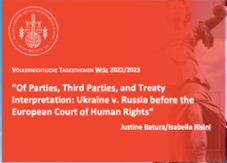
Webinar on Ukraine v. Russia before the European Court of Human Rights

On 1 February, the Walther Schücking Institute for International Law at the Christian-Albrechts-Universität (Kiel) will hold an online seminar entitled "Of Parties, Third Parties, and Treaty Intertretation: Ukraine v. Russia before the European Court of Human Rights". The speakers include Isabella Risini and Justine Batura. 

Here is a brief summary of the event:

"An unprecedented number of member States have requested permission to intervene in the case Ukraine v. Russia (X) before the European Court of Human Rights. The significance that can be ascribed to these interventions goes beyond a mere expression of solidarity with Ukraine. Not only are these third-party interventions a timely and much needed opportunity for States to express their support for the European regional human rights system and convey legitimacy to the later judgment. The procedural instrument under Art. 36 § 2 ECHR also provides States the prime opportunity to express views on the interaction of international humanitarian law and human rights law in the wake of Georgia v. Russia (II). In this edition of the “Völkerrechtliche Tagesthemen”, Justine Batura and Isabella Risini discuss the context and value of the third-State interventions. 

A critical assessment of this phenomenon will be part of the presentation. While it is true that more than half of all member States of the Council of Europe have expressed interest in intervening as third-party in Ukraine’s application concerning the Russian full-scale invasion in February 2022, it is also worthwhile noting that the States in question also could have submitted their own application against Russia. Member States’ interest in this conflict, which started back in 2014, is also relatively recent."

To register for this event, you must send an email to tagesthemen[at]wsi.uni-kiel.de.

Monday, 23 January 2023

New Handbook on the ECHR

Mark Villiger, former judge at the European Court of Human Rights and professor emeritus at the University of Zürich, has just published a new Handbook on the European Convention on Human Rights with Brill. It is oriented towards practice and covers both the organisation of the Court itself, procedural and substantive issues - all in one volume. A welcome addition to the growing landscape of ECHR  handbooks!  This is the abstract:

'In clear and concise words, this Handbook offers a comprehensive and up-to-date overview of the European Convention and the European Court of Human Rights and its case-law. Numerous cross-references guide the reader through the various topics. Various summaries condense the different principles of the Court’s case-law. 

The Handbook has been written largely for practitioners such as lawyers, judges and persons in administrative functions, but will also be invaluable to university teachers and academic researchers. Meticulously compiled, authoritative and practical, it is a must-have resource for anyone concerned with the protection of human rights in Europe. 

The author served as a Judge at the Court for nine years, three of them as Section President. He is a retired Professor for International and European Law at the University of Zurich in Switzerland. 

With a Foreword by Judge Robert Spano, President of the European Court of Human Rights.'

Thursday, 19 January 2023

New Book on Combating Hate Speech During Electoral Processes

The Council of Europe has published the new book Toolkit on combating hate speech during electoral processes. Here is a brief summary:

'Freedom of expression is enshrined in the European Convention on Human Rights and protects citizens from interference with their right to freely express their opinions. This freedom is essential when it comes to the electoral process which, like any competition, has a strict framework of rules. Freedom of expression must not give rise to hate speech that would undermine the electoral process by polluting the campaign and political debate necessary for voters to make an informed choice.

This toolkit is intended to explain the international standards applicable in this respect, provide tools and strategies that can be used by election management bodies to counter hate speech harmful to free electoral competition and describe the Georgian experience in this area.'