Friday, 25 February 2022

Ukraine, the Suspension of Russia in the CoE, and Infringement Proceedings in Turkish Kavala Case

As the very worrisome and sad events of the Russian invasion of Ukraine are rapidly and brutally unfolding this week, causing both human suffering and human rights violations, the very fabric of peace and the international rule of law in Europe seem to be deeply at stake. The Council of Europe has just announced suspending Russia's voting rights in the Council of Europe. It announced:

"In line with the Statute of the Council of Europe, the Committee of Ministers has today decided to suspend the Russian Federation from its rights of representation in the Committee of Ministers and in the Parliamentary Assembly with immediate effect as a result of the Russian Federation’s armed attack on Ukraine.

The decision adopted today means that the Russian Federation remains a member of the Council of Europe and party to the relevant Council of Europe conventions, including the European Convention on Human Rights.

The judge elected to the European Court of Human Rights in respect of the Russian Federation also remains a member of the Court, and applications introduced against the Russian Federation will continue to be examined and decided by the Court. Suspension is not a final measure but a temporary one, leaving channels of communication open."

And apart from Ukraine itself several neighbouring countries have announced a state of emergency.

It raises, once again, the issue of how the Council of Europe, and its ECHR system should deal with states flouting their human rights and other commitments. Earlier this week, another development at the Council of Europe also occurred as part of this broader debate. For only the second time in history, the Committee of Ministers, in its supervisory function re the execution of judgments of the European Court initiated an infringement procedure under Article 46, para. 4 ECHR. The situation relates to the case of the imprisoned businessman and human rights defender Mehmet Osman Kavala. In December 2019, the Court had found violations of both Articles 5 and 18 and indicated Turkey should release him. The Grand Chamber will now have to appraise whether Turkey has failed in its obligation to execute the binding judgments of the Court. A very rare step in itself.

Monday, 21 February 2022

The Court in 2021: (worrying) facts and figures

Each year, the European Court of Human Rights issues annual reports that provide an overview of its activities, case-law and other facts and figures. The 2021 reports were issued last week, and are available herehere and here

The overview of the Court’s case-law showcase a summary of key judgments that have further elucidated or developed standards under each Convention article. For example, it elaborates how Georgia v. Russia II has shaped the understanding of extraterritoriality under Article 1, how Kurt v Austria has strengthened the standards of protection with regards to domestic violence under Article 2, and so on.

Facts and figures show the number of cases received, allocated and decided by the Court, as well as what rights have been predominantly violated in Europe and by whom.

Within a year, the Court has issued 1105 judgments in relation to more than 3000 applications (some cases were joined), and has decided more than 36000 applications with a judgment, decision or by striking the case out of the list.

More than 20% of the judgments concerned the right to a fair trial, 19% in relation to the prohibition of torture, 18% in relation to the right to liberty and security and 9% concerning the right to respect for private life.

Similar to last year, a quarter of all applications before the Court were lodged against Russia, 21% against Turkey, 16% against Ukraine, 8% against Romania, and 5% against Italy. It is worrying that, just like in the previous years (see here and here) more than 75 % of applications were brought against 5 states only. These facts and figures suggest that the number of cases before the Court cannot be reduced only by reforming the 'machinery'. A more meaningful and holistic analysis is needed to look at the causes and types of violations, and how to ensure that all States, and in particular the 'usual suspects' that top the number of applications, take seriously the obligation to respect human rights, as enshrined in Article 1 of the Convention. 

Wednesday, 16 February 2022

New Thematic Factsheet on Roma and Travellers

The Department for the Execution of Judgments of the ECHR has issued a new
 thematic factsheet on the execution of the Strasbourg Court judgments on 'Roma and Travellers'. The Council of Europe uses the terms 'Roma and Travellers' to encompass the wide diversity of certain disadvantaged groups, including Roma, Balkan Egyptians, Eastern groups (Dom, Lom and Abdal) and groups such as Travellers, Yenish, and the populations designated under the administrative term “Gens du voyage”, as well as persons who identify themselves as Gypsies.

Here is a brief summary of the factsheet:

"The European Court has underlined that as a result of their history, the Roma have become a specific type of disadvantaged and vulnerable minority, therefore requiring special protection. It has noted that their vulnerable position means that special consideration should be given to their needs and their different lifestyle, both in the relevant regulatory framework and in reaching decisions in particular cases.

The new factsheet provides examples of general and individual measures reported by States in the context of the execution of the European Court’s judgments, concerning notably: access to justice, right to respect for private and family life, including issues related to forced sterilisation of Roma women, protection from hate crime and housing rights, protection of property and right to education."

Monday, 14 February 2022

New ECHR Readings

Please find below a new batch of ECHR-related publications of the last few months. More will follow in some of our subsequent posts.

Başak Çalı and Esra Demir-Gürsel, ‘The Council of Europe’s Responses to the Decay of the Rule of Law and Human Rights Protections: A Comparative Appraisal’, ECHR Law Review, 2021, Vol. 2, Issue 2:

‘This article introduces the Special Issue on ‘The Responses of the Council of Europe to the Decay of the Rule of Law and Human Rights Protections’. The Council of Europe (CoE), a unique international organisation with its commitment to protect and promote human rights, the rule of law, and democracy, has been severely tested by the spread and consolidation of trends posing systemic threats to its foundational goals. The authors of this Special Issue assess how the European Court of Human Rights, the Venice Commission, the Parliamentary Assembly, the Committee of Ministers, and the office of the Secretary General have addressed systemic threats to the foundational principles of the organisation in the last decade. The Special Issue finds that the respective legal-institutional features and capacities of the CoE organs as well as the constraining influence of the broader political context in Europe on them vary significantly, hampering the CoE’s ability to produce timely, consistent, and co-ordinated responses against systemic threats.’

Kushtrim Istrefi and Cedric Ryngaert, ‘Makuchyan and Minasyan v Azerbaijan and Hungary: Novel Questions of State Responsibility, Presidential Pardon, and Due Diligence of Sentencing Transfer Meet in a Rare Case of the Right to Life’, ECHR Law Review (14 September 2021) [case note]

Elif Erken, ‘Non-Governmental Organisations and National Human Rights Institutions monitoring the execution of Strasbourg Judgments: An Empirical Perspective on Rule 9 Communications’, Human Rights Law Review, 2021, Vol. 21, Issue 3, pp. 724–751:

‘This article considers a scarcely explored perspective in relation to the execution of judgments of the ECtHR, notably, the formal involvement of NGOs and NHRIs. Rule 9(2) of the Committee of Minister Rules’ allows NGOs and NHRIs to participate in the supervision process for the execution of the Court’s judgments by submitting reports (Communications) in which these actors review and assess domestic authorities’ performance with respect to judgment execution. On the basis of interviews with important stakeholders, this article provides an all-round user-based perspective of this Rule 9 mechanism and its perceived impact. Doing so elucidates whether the Rule 9 procedure allows NGOs and NHRIs to engage in the important cycle of reporting and pressuring for change, the conclusions of which are important in assessing if and how Rule 9 works to advance the execution of judgments of the ECtHR.’

Toon Moonen & Laurens Lavrysen, ‘Abstract but Concrete, or Concrete but Abstract? A Guide to the Nature of Advisory Opinions under Protocol No 16 to the ECHR’, Human Rights Law Review, 2021, Vol. 21, Issue 3, pp. 752–785.

‘In constitutional adjudication, a well-known distinction exists between abstract and concrete review. Under abstract review, a court evaluates a rights interference detached from any particular application to the facts of a case. Under concrete review, the review arises as an element of adjudication of specific facts. In this contribution, we explain theoretically how this distinction plays both at the macro level of a review system and the micro level of specific cases. These concepts are then used to explore and understand the advisory procedure recently introduced by Protocol No 16 to the European Convention on Human Rights. We argue that this mechanism theoretically provides for a type of review that is more abstract than the review exercised under the European Court of Human Rights’ contentious jurisdiction, yet still allows for important elements of concreteness to enter the analysis. This is confirmed by Advisory Opinions Nos 1 and 2.’

Yutaka Arai-Takahashi, ‘Arguable but Superfluous? – Judicial Policies of the European Court of Human Rights in Relation to the Right to an Effective Remedy Before a National Authority Under Article 13 ECHR’, Israel Yearbook on Human Rights, 2021, Vol. 51.
 
Eugénie Delval, ‘The Kunduz airstrike before the European Court of Human Rights: a glimmer of hope to expand the Convention to UN military operations, or a tailored jurisdictional link?’, The Military Law and the Law of War Review, 2021, pp. 244-275:
‘On 16 February 2021, the Grand Chamber of the European Court of Human Rights ruled, in Hanan v. Germany, that Germany exercised its extraterritorial jurisdiction for the purpose of its procedural obligation under Article 2 of the European Convention on human rights to investigate the airstrike it carried out in Afghanistan within the framework of a United Nations Security Council resolution. To establish an extraterritorial jurisdictional link, the Court relied on the ‘special features’ threshold that it has recently introduced in its jurisprudence, along with the threshold of the ‘institution of a criminal investigation’. This potentially extends the standards of protection under the ECHR to situations where Contracting States are carrying out massive military operations in armed conflict, such as airstrikes, even within the framework of a UN mandate. Nonetheless, the Court remains cautious not to formulate general theories of jurisdiction and retains a very strict (and casuistic) control over the new jurisdictional thresholds.’

Lorenzo Acconciamessa, ‘The Case Law of the ECtHR in 2020 in the Light of the Principle of Systemic Harmonisation’, in Philip Czech et. al. (eds.), European Yearbook on Human Rights2021 (Intersentia 2021).

And finally, Yota Negishi, of Seinan Gakuin University in Japan, has published monograph with a comparative study of the ECHR and the Inter-American Human Rights system, entitled Conventionality Control of Domestic Law: Constitutionalised International Adjudication and Internationalised Constitutional Adjudication, with Nomos:

'Through gaining lessons from the doctrine of constitutionality control, the book deals principally with conventionality control achieved by judicial adjudicators. This monograph fills the gap in comparative international human rights law by analysing the practice of conventionality control in Europe and Latin America. Based on the empirical data, the author normatively envisions a ‘trapezium’ model of conventionality control with the features of openness, substantivism and human-centrism, which overcomes the limits of the closed, formalist, and State-centric ‘pyramid‘ model.'

Wednesday, 9 February 2022

ECHR MOOC Starts Again on 10 February

Utrecht University's free Massive Open Online Course (MOOC) on the ECHR is starting again this week, on 10 February 2021. Registration is open now! To enroll, please go to the Coursera platform.

The MOOC entitled 'Human Rights for Open Societies - An introduction into the ECHR' is taught by myself (Antoine Buyse) and my Utrecht University colleagues professor Janneke Gerards and Claire Loven. This is the abstract of our six-week course:

'Human rights are under pressure in many places across the globe. Peaceful protests are violently quashed. Voting is tampered with. And minorities are often excluded from decision-making. All of this threatens the ideal of an open society in which each of us can be free and participate equally. A solid protection of human rights is needed for an open society to exist and to flourish. But it is often an uphill battle to work towards that ideal. Equip yourself and learn more about what human rights are and how they work. 

In this course, we will introduce you to one of the world’s most intricate human rights systems: the European Convention on Human Rights. You will see when and how people can turn to the European Court of Human Rights to complain about human rights violations. You will learn how the Court tries to solve many of the difficult human rights dilemmas of today. We will look, amongst other things, at the freedom of expression and demonstration, the right to vote, and the prohibition of discrimination. And we will address the rights of migrants, refugees, and other vulnerable groups. And, of course, we will see whether it is possible to restrict rights and if so under what conditions. You will even encounter watchdogs and ice cream in this course. We invite you to follow us on a journey of discovery into the European Convention!'


Please watch this short introduction video to get an impression:

Tuesday, 8 February 2022

Online Seminar on the ECHR: Environmental Claims; Contemporary Issues

On Wednesday 9 February 2022,from 14h00 to 17h00 GMT, the Human Rights Law Centre of the University of Nottingham is organising an online seminar on the ECHR. This is the announcement by the organisers:

'The Seminar is being held in honour of Emeritus Professor Alastair Mowbray, a leading academic expert on the ECHR, who recently retired from the Law School, University of Nottingham. His major works included The Development of Positive Obligations under the European Convention on Human Rights by the European Court of Human Rights and Cases and Materials on The European Convention on Human Rights.

The first session is concerned with environmental and climate change claims. There is widespread interest in these issues, particularly after the UN Climate Change Conference (COP26) (2021). The second session considers a number of major contemporary issues under the ECHR.'

The seminar will be held in MS Teams and can be joined through this link. This is the programme:

Session I: 2 - 3:30pm: The European Convention on Human Rights: Environmental Claims
Chair: Professor Dominic McGoldrick, University of Nottingham

2:00 - 2:05pm: Introduction
2:05 - 2:25pm: ‘Adjudicating Environmental Claims under The European Convention on Human Rights’ Lucy Maxwell, Climate Litigation Network.
2:25 - 2:45pm: ‘Remedies before the ECtHR and their Potential for Climate Change Cases’ Corina Heri and Reka Piskoty, University of Zurich, Switzerland.
2:45 - 3:05pm: ‘Children’s rights and environmental claims: strategic litigation’ Professor Aoife Nolan, University of Nottingham.
3:05 - 3:30pm: Questions and Discussion

Fifteen minute refreshment break

Session II: 3:45 - 5:00pm: The European Convention on Human Rights: Contemporary Issues
Chair: Emeritus Professor David Harris, University of Nottingham

3:45 - 3:50pm: Introduction
3:50 - 4:10pm: ‘The right of individual application in 2022: still a cornerstone of the Convention?’ Professor Ed Bates, University of Leicester.
4:10 - 4:30pm: ‘The influence of human rights on the development of the tort of misuse of private information in English law’ Judith Skillen, University of Nottingham.
4:30 - 4:50pm: ‘Human Rights Dialogue in English Criminal Procedure?’ Professor Paul Roberts, University of Nottingham.
4:50 - 5:00pm: ‘Concluding Reflections’, Emeritus Professor Alastair Mowbray, University of Nottingham.

Tuesday, 25 January 2022

Public Lecture on Positive Obligations under the ECHR - Within and Beyond Boundaries

On 10 March, the University of Liverpool is hosting an online public lecture by Dr. Vladislava Stoyanova on Positive Obligations under the European Convention on Human Rights - Within and Beyond Boundaries. Here is a brief description of the event:

'The development of positive obligations has been one of the hallmarks of the work of the European Court of Human Rights (ECtHR or the Court) in interpreting the European Convention on Human Rights (ECHR). Various issues from various spheres of life have been reviewed by the Court as involving possible breaches of positive obligations. Given the extensive regulatory functions of the State and the enormous breadth of state activities, any harm could potentially be a ground for making an argument that the State failed to fulfil its positive human rights obligations by failing to prevent or mitigate harm or risk. As a result, it is rather unclear under which conditions positive obligations may be triggered and how far-reaching they may be, given how difficult it is to draw the boundaries of state responsibility for omissions. The difficulties in determining and delimiting the role of the State in the contemporary society contribute to this uncertainty.

The lecture will address these challenges by identifying the key analytical issues that need to be considered in determining whether a State is responsible under the ECHR for omissions. The focal question is whether and how omissions by the State can be conceptualised into failures to fulfil positive obligations. In addition to this technical analytical question, the project also reflects upon what is at stake for the political community when the triggering, the content, and the scope of positive human rights obligations are determined. A central question is then how the search for a balance between intrusion and restraint by the State, between protection and freedom from invasion, defines this community and pulls the analysis of state responsibility for omissions in different directions.

One of these key analytical issues is the competition between obligations. In particular, positive human rights obligations can compete, and even conflict, with other human rights obligations, both positive and negative. This is important since protection might lead to diversion of resources, potentially in breach of other positive obligations, and unjustifiable forms and levels of intrusiveness and coercion that might be in breach of negative obligations. The latter can be particularly disturbing in light of the tension between obligations that constrain state power (negative obligations) and obligations that mandate state power or demand its more expansive exercise (positive obligations). These tensions are relevant all the time when positive obligations are at stake, although they not always explicit in the Court’s reasoning. The tensions imply that the more the State protects certain interests, the less it might be able to protect and the more it might interfere with other interests.

The specific concern will be then how competing human rights obligations owned by the State need to be taken into consideration in the determination of the scope and the content of positive obligations, so that a possible protective overreach can be prevented. The speaker will first explain that obligations need to be specified so that tensions and competitions between obligations become cognizable. Once competing obligations become cognizable, they should be denoted a distinctive and special role (in contrast to competing general public interests) in the assessment of the reasonableness of the positive obligations. Then it will discuss considerations that can be relevant to addressing the tension between positive obligations and other (both positive and negative) human rights obligations corresponding to absolute, strictly qualified and qualified rights. These considerations include respecting the equal moral status of each affected individual, the relative importance of the affected interests grounding rights as related to the relative importance of the corresponding obligations, whether actions or omissions form the content of the obligations, and the determinacy of the harm and the affected individuals. Finally, while acknowledging the difficulties, it is proposed that the obligations can be farmed in such a way in terms of content and scope, so that accommodation is possible.'

You can register here

Friday, 14 January 2022

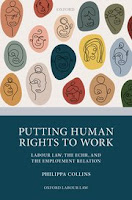
New Book: Putting Human Rights to Work

Philippa Collins, a lecturer at the University of Bristol, has published a book entitled 
Putting Human Rights to Work: Labour Law, the ECHR, and the Employment Relation (with Oxford University Press). 

Here is a short description of the book:

"The very existence of an employment relationship places the human rights of a worker at risk. Employers can, and frequently do, exercise their managerial and disciplinary powers in a manner that interferes with the most fundamental rights of the individual worker. Adequate safeguards against such infringements are necessary if individuals are to receive full protection of their rights. This book examines how far the labour laws of England and Wales offer such guarantees, with a particular focus on dismissal law. The chapters reflect on the relationship between employment, labour, and human rights before conducting a detailed and critical analysis of the scope, shape, and application of domestic employment law. The framework for evaluation is drawn from the case law of the European Court of Human Rights, as it develops a principled and tailored approach to how the rights contained in the European Convention on Human Right should be enforced in working relationships. Statutory mechanisms, such as the law of unfair dismissal, and common law causes of action are examined and found to be lacking in their capacity to vindicate and enforce the human rights of workers. This book culminates in the proposal and elaboration upon an innovative solution, the Bill of Rights for Workers, that would draw on the successes of human rights and labour law instruments to render the Convention rights directly enforceable in the relationship between a worker and their employer."

Monday, 10 January 2022

EIN Colloquium on Implementation of Judgments in French

On 18 February, the European Implementation Network (EIN) in Strasbourg is organising an in-person colloquium on how NGOs and NHRI can effectively participate in the supervision process of implementation of judgments of the European Court of Human Rights. The event will take place in French. More information can be found here and this is the announcement of the event by the organisers:

'Les arrêts de la cour Européenne des Droits de l’Homme (CEDH) impliquent souvent, au-delà des mesures individuelles concernant la victime, la mise en œuvre de mesures générales – de nature législatives ou autres - qui ont un impact fort sur l’état des droits humains de tout un chacun dans un Etat. De par leur expertise et leur connaissance du terrain, les ONG et INDH, mais également les organisations professionnelles telles que Conseil des Barreaux ou Syndicat des avocats, sont parmi les mieux placées, à côté des autorités étatiques, pour formuler des recommandations sur les mesures substantielles nécessaires à la bonne exécution d’un arrêt, qui permettront d’éviter des violations identiques à l’avenir. En ceci, la participation des ONG, INDH et organisations professionnelles au processus de supervision de l’exécution des arrêts de la CEDH constitue un élément important pour la protection de l’Etat de droit en Europe, et dans l’UE en particulier.

Pour autant, la participation de ces structures au processus de supervision des arrêts de la Cour reste encore très limitée – seules 5-7% des affaires en ont bénéficié la dernière année – et le processus en tant que tel, ainsi que son potentiel pour la protection de l’Etat de droit dans l’UE, reste méconnu.

Ce Colloque a pour but de sensibiliser et former ONG, INDH et organisations professionnelles au rôle clef qu’elles peuvent et devraient jouer pour accompagner une meilleure exécution des arrêts de la CEDH, et de formuler un Appel, enrichi de recommandations concrètes, envers les institutions européennes, afin que ce volet soit dûment pris en compte dans les rapports et politiques de l’UE en faveur de l’Etat de droit. Un élément essentiel sera l’appel à une plus grande prise en compte des besoins de financements des ONG/INDH dans le cadre du programme « Citoyens, égalité, droits et valeurs », et du volet « Valeur de l’Union » qui est au cœur de ce programme. L’Appel et ses recommandations seront relayés par l’EIN sur la plateforme de la Conférence sur l’Avenir de l’Europe.'

Wednesday, 5 January 2022

The New Year and What is Coming up at the Court

First off, our very best wishes for the new year to all our readers for 2022! Before focusing on a number of matters ahead in the ECHR system, one decision emanating from the Court in the last days of 2021 also deservers attention. So, we start the year with a number of notifications:

1. As the Court announced in one of its last press releases of last year, the much contested dissolution of Russia's oldest human rights NGO Memorial will be reviewed under the ECHR. In the meantime, and as far as we are aware, applying interim measures for the first time in a freedom of association case, the Court requested Russia to suspend enforcing the domestic court decision to close the NGO and its affiliates. This is the message on the ECtHR's own website: 

'On 28 and 29 December 2021 respectively, the International Memorial and the Memorial Human Rights Centre reiterated their request to the European Court of Human Rights under Rule 39 of the Rules of Court to apply an interim measure to prevent their forced dissolution following the adoption of the judgments of 28 and 29 December 2021 by the Supreme Court of Russia and by the Moscow City Court, respectively.

The Court has decided to indicate to the Government of Russia, under Rule 39, that in the interests of the parties and the proper conduct of the proceedings before it, the enforcement of the decisions to dissolve the applicant organisations should be suspended for a period that would be necessary for the Court to consider the application.'

2. Looking ahead, this month will witness one of the Court's most awaited hearings of recent times, the one in the inter-state case Ukraine and The Netherlands v the Russian Federation. Inter-state cases are rare and always very sensitive. The hearing was already deferred from last year and the cases focuses on the downing of infamous Malaysia Airlines flight MH-17 in 2014 above Ukraine during the armed conflict there. Meanwhile, the criminal case against four main suspects in absentia is progressing in Dutch domestic courts, in parallel. The hearing in Strasbourg is now scheduled for 26 January. 

3. And finally, a crucial change for potential applicants will enter into force on 1 February. From then on, the time-limit for submitting a complaint in Strasbourg will be reduced from 6 to 4 months after exhausting domestic remedies. This is the most visible change resulting from the entry into force of Protocol 15 ECHR last year, of which the transition period ends in a few weeks. New applications submitted after 1 February can only be declared admissible if they comply with this new time limit.