Wednesday, 5 January 2022

The New Year and What is Coming up at the Court

First off, our very best wishes for the new year to all our readers for 2022! Before focusing on a number of matters ahead in the ECHR system, one decision emanating from the Court in the last days of 2021 also deservers attention. So, we start the year with a number of notifications:

1. As the Court announced in one of its last press releases of last year, the much contested dissolution of Russia's oldest human rights NGO Memorial will be reviewed under the ECHR. In the meantime, and as far as we are aware, applying interim measures for the first time in a freedom of association case, the Court requested Russia to suspend enforcing the domestic court decision to close the NGO and its affiliates. This is the message on the ECtHR's own website: 

'On 28 and 29 December 2021 respectively, the International Memorial and the Memorial Human Rights Centre reiterated their request to the European Court of Human Rights under Rule 39 of the Rules of Court to apply an interim measure to prevent their forced dissolution following the adoption of the judgments of 28 and 29 December 2021 by the Supreme Court of Russia and by the Moscow City Court, respectively.

The Court has decided to indicate to the Government of Russia, under Rule 39, that in the interests of the parties and the proper conduct of the proceedings before it, the enforcement of the decisions to dissolve the applicant organisations should be suspended for a period that would be necessary for the Court to consider the application.'

2. Looking ahead, this month will witness one of the Court's most awaited hearings of recent times, the one in the inter-state case Ukraine and The Netherlands v the Russian Federation. Inter-state cases are rare and always very sensitive. The hearing was already deferred from last year and the cases focuses on the downing of infamous Malaysia Airlines flight MH-17 in 2014 above Ukraine during the armed conflict there. Meanwhile, the criminal case against four main suspects in absentia is progressing in Dutch domestic courts, in parallel. The hearing in Strasbourg is now scheduled for 26 January. 

3. And finally, a crucial change for potential applicants will enter into force on 1 February. From then on, the time-limit for submitting a complaint in Strasbourg will be reduced from 6 to 4 months after exhausting domestic remedies. This is the most visible change resulting from the entry into force of Protocol 15 ECHR last year, of which the transition period ends in a few weeks. New applications submitted after 1 February can only be declared admissible if they comply with this new time limit. 

Friday, 24 December 2021

Last post of 2021: Covid, Architects and Spaghetti Monsters

Dear readers, as another Covid-19 year slowly grinds to a halt, this is the last post of 2020, as this blog will take a Winter break. 

For the European Court of Human Rights this was another challenging year, with what we could call the start of a substantive Covid-19 case-law line, relating to such issues as freedom of movement and mandatory vaccination. No doubt, there will be more to come. And the general human rights situation within the ECHR's geographical reach remains worrying, with new judgments finding violations of Article 18 ECHR for example and a continuing series of cases about (the lack of) judicial independence. Enough reasons for this blog to continue following Strasbourg developments in the year ahead.

It was also the year in which the architect of the Court's current, iconic building passed away: Sir Richard Rogers. And also, to end with a comic note, the year in which Pastafarianism, the movement venerating the Flying Spaghetti Monster, was not recognised as a religion under Article 9 ECHR by the Court. 

We wish all our readers a good holiday season and a healthy 2022!
Antoine Buyse and Kushtrim Istrefi, co-editors of the ECHR Blog

Tuesday, 21 December 2021

Academic Freedom in Turkey before the Strasbourg Court: A Third Party Intervention by a Coalition of Academic Interveners

This week a coalition of academics, including this blog's editors, has submitted a third party intervention to the European Court of Human Rights in the so-called 'Academics for Peace' cases.

The background of these cases is the following: in the wake of the failed coup d'état of July 2016, the Turkish Government has employed emergency measures not only to re-establish peace and order, and to deal with those directly responsible for the coup d'état, but also to silence and in many cases attack, among others, journalists, academics or minorities. These systemic attacks undermine the overall academic freedom in Turkey.

This currently pending group of applications before the European Court of Human Rights, the 'Academics for Peace' cases (Kamuran AKIN v. Turkey and 42 other applications, applications nos. 72796/16, 72798/16, 72799/16 et al.), illustrate this. The cases concern a group of academics from different Turkish universities who on 11 January 2016 issued a statement entitled “We will not be a party to this crime”, which critically questioned the Turkish Government’s role in the conflict in South-East Turkey and the associated serious human rights violations. President Erdoğan accused them of treason, and hundreds of academics, including the applicants, were then dismissed from their university positions through a series of emergency decrees. 

The group of academics who submitted the third-party intervention before the European Court of Human Rights addresses the connection of the cases with academic freedom and elaborates on the importance of academic freedom in and for the Convention system. The third party intervention was presented by Professors Helen Duffy and Philip Leach (co-supervisors in the Turkey Litigation Support Project) on behalf of a group of 19 academics, including the co-editors of this blog (Antoine Buyse  and Kushtrim Istrefi).

Friday, 17 December 2021

New Book: Framing a Convention Community

Cedric Marti of the University of Zurich has published a book entitled Framing Convention Community: Supranational Aspects of the European Convention on Human Rights (with Cambridge University Press). 

Here is the book abstract:

'The European Convention on Human Rights (ECHR) has evolved from an international agreement into a highly integrated legal community with an ever more pervasive effect on domestic law and individuals. The supranational authority of the European Court of Human Rights bypasses the national state in a growing number of other areas. Understanding the evolution of the ECHR and its Court may help in explaining and contextualising growing resistance against the Court, and in developing possible responses. Examining the Convention system through the prism of supranationality, Cedric Marti offers a fresh, comprehensive and interdisciplinary perspective on the expanding adjudicatory powers of the Court, including law-making. Marti addresses the growing literature of institutional studies on human rights enforcement to ascertain the particularities of the ECHR and its relationship to domestic legal systems. This study will be of great value to both scholars of international law and human rights practitioners.'

Monday, 13 December 2021

Secretary General Inquires on the Situation in Poland: A Test for Poland and Article 52 ECHR

On 24 November 2021, the Polish Constitutional Court issued a ruling that challenged both the authority of the European Court of Human Rights to decide on the lawfulness of appointment of judges in national courts, and the standards of fair trial under the Convention. In response to this worrying development, on 7 December 2021, the Secretary General of the Council of Europe requested the Polish Government “to furnish explanations concerning the manner in which [its] … internal law ensures the effective implementation of Article 6 and 32 of the Convention following the judgment of the [Polish] Constitutional Court of 24 November in the case K 6/21”. 
 
The Secretary General explained that the legal basis for this inquiry is based on Article 52 of the Convention, which provides that “[o]n receipt of a request from the Secretary General … any High Contracting Party shall furnish an explanation of the manner in which its internal law ensures the effective implementation of any of the provisions of the Convention”. 
 
A textual interpretation of Article 52 ECHR (e.g. words ‘shall furnish’) suggests that Poland is obliged to provide in due time all the necessary information requested by the Secretary General. It has also been observed in the past that when the Secretary General triggers Article 52:
 
The State has the obligation to provide truthful explanations... The State has an obligation of result to provide explanations about the effective implementation of the Convention in its internal law: the State cannot, therefore, confine itself to providing explanations of a formal nature. On the contrary, bearing in mind also the obligation to execute treaty obligations in good faith …, a State has the obligation to furnish precise and adequate explanations which make it possible to verify whether the Convention is actually implemented in its internal law. This necessarily implies that the State must furnish information of a sufficiently detailed nature about the national law and the practice of the national authorities, in particular the judicial authorities, and about their conformity with the Convention as interpreted in the case-law of the European Court of Human Rights.
 
Poland was asked to answer to the Secretary General no later than 7 March 2022. It remains to be seen how or if Poland will respond to this inquiry. The Secretary General may again follow up with Poland on this or other issues concerning the Convention given that Article 52 does not prevent the Secretary General from making further inquiries with State parties to the ECHR.
 
It must be noted that Article 52 has scarcely been used in the past and remains a rather under researched provision. There seem to be no clear procedures on how and when the Secretary General issues inquiries under the ECHR, or what happens if a State does not provide timely  and truthful explanations to the Secretary General. The aim of Article 52 is also rather vague. Article 52 was inspired by a draft article on the UN covenants that provided for ‘a right to interrogation’ when States do not comply with human rights. Yet, this does not imply that the Secretary General may or should use Article  52 to ‘interrogate’ States. The Secretary General may strategically decide to employ it in order to engage in a form of dialogue with States.
 
In light of the foregoing, the outcome of the Secretary General’s inquiry on Poland may prove to be important not only for the present case, but also for the future potential of Article 52 ECHR.

Wednesday, 8 December 2021

New Book on the ECtHR and European Public Order

Kanstantsin Dzehtsiarou of the University of Liverpool has just published a new book with Cambridge University Press, entitled Can the European Court of Human Rights Shape European Public Order? It is available as print book and in electronic version. This is the abstract: 

'In this book, Kanstantsin Dzehtsiarou argues that, from the legal perspective, the formula 'European public order' is excessively vague and does not have an identifiable meaning; therefore, it should not be used by the European Court of Human Rights (ECtHR) in its reasoning. However, European public order can also be understood as an analytical concept which does not require a clearly defined content. In this sense, the ECtHR can impact European public order but cannot strategically shape it. The Court's impact is a by-product of individual cases which create a feedback loop with the contracting states. European public order is influenced as a result of interaction between the Court and the contracting parties. This book uses a wide range of sources and evidence to substantiate its core arguments: from a comprehensive analysis of the Court's case law to research interviews with the judges of the ECtHR.'

Monday, 29 November 2021

Online Training on Combating Violence Against Women and Domestic Violence and the ECHR

The European Implementation Network is organising a free online training on 16 December on the topic 'Combatting violence against women and domestic violence by supporting the implementation of judgments of the European Court of Human Rights'. It is aimed at practitioners and will be held in English with a possibility of simultaneous interpretation into Russian if the need arises. The full programme can be found here and the organisers kindly ask potential participants to register before the end of this week (so before 3 December) here. This is the abstract of the training:

'Violence against women and domestic violence (“VAW/DV”) are grave violations of human rights and forms of discrimination. They occur in every Council of Europe member state, despite some positive developments in law, policies and practices. Shortcomings in domestic legal frameworks, the lack of specialized social services and discriminatory practices and attitudes have all been contributing to the perpetuation of domestic violence. The coronavirus is exacerbating the issue. The forced cohabitation of many families around the world has shown signs of a real ‘emergency in an emergency’. 

Governments have a responsibility to respect, protect and fulfil the human rights of all their citizens. However, in the area of violence against women and domestic violence, many are failing to carry out the reforms necessary – and will only do so as a result of sustained pressure at the national and international levels. 

Judgments from the European Court of Human Rights (“ECtHR”) have an invaluable role to play in pushing authorities to make the necessary reforms. Nevertheless, in order for effective reforms to result from the ECtHR implementation process, it is often essential that actors on the ground are empowered to actively engage in the process for implementing the judgment. 

On 16th December, EIN will organise an online training dealing with the implementation of ECtHR judgments in the field of VAW/DV. This online training is a core element of an EIN project supported by the Permanent Representation of Luxembourg to the Council of Europe. The project aims to provide comprehensive support to specialist organisations, to ensure that they can effectively contribute to the ECtHR implementation monitoring system, in every country where there is an ECtHR judgment concerning domestic violence pending implementation. The objective of the training is to sensitize expert organisations about the importance of their contribution to the implementation of judgments in this area, and equip them with tools on how to make best use of the supervision process.' 

Friday, 19 November 2021

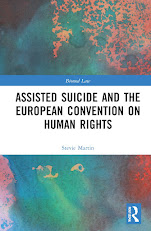
New Book: Assisted Suicide and the European Convention on Human Rights

Stevie Martin (University of Cambridge) has published a book titled Assisted Suicide and the European Convention on Human Rights  (Routledge). On 4 November, the book won the Yorke Prize - an annual award of the Faculty of Law at the University of Cambridge for a publication of exceptional quality, which makes a substantial contribution to a field of legal knowledge.


Here is the abstract of the book:
 
"Locating assisted suicide within the broader medical end-of-life context and drawing on the empirical data available from the increasing number of permissive jurisdictions, this book provides a novel examination of the human rights implications of the prohibition on assisted suicide in England and Wales and beyond. Assisted suicide is a contentious topic and one which has been the subject of judicial and academic debate internationally. The central objective of the book is to approach the question of the ban’s compatibility with the European Convention on Human Rights afresh; freed from the constraints of the existing case law and its erroneous approach to the legal issues and selective reliance on empirical data. The book also examines the compatibility of the ban on assisted suicide with rights which have either been erroneously disregarded or not considered by either the domestic courts or the European Court of Human Rights. Having regard to human rights jurisprudence more broadly, including in the context of abortion, the research and analysis undertaken here demonstrates that the ban on assisted suicide violates the rights of a significant number of individuals to life, to freedom from torture or inhuman or degrading treatment and to private life. Such analysis does not depend on a strained or contrived approach to the rights at issue. Rather, the conclusions flow naturally from a coherent, logical application of the established principles governing those rights.  
 
While the focus of the book is the Suicide Act 1961, the conclusions reached have implications beyond England and Wales, including for the other devolved jurisdictions and international jurisdictions. Beyond courts and legislators, it will be a valuable resource for students of human rights and medical law, as well as medical and legal practitioners and academics working in human rights and end-of-life care."

Thursday, 18 November 2021

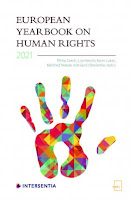
Call for Contributions: European Yearbook on Human Rights 2022

The European Yearbook on Human Rights has issued a call for contributions for its 2022 issue. The Yearbook publishes mostly about the European Convention on Human Rights and the Council of Europe. It also contains sections on human rights in the European Union, the Organisation for Security and Co-operation in Europe as well as cross-cutting analysis and commentary.

Here is the description of the call:

The European Yearbook on Human Rights is shedding light on current human rights topics of concern and the most pressing issues that impair human rights protection, the rule of law and democracy in Europe and beyond. 

The Yearbook is supported by three major Austrian human rights institutions dedicating their work to researching, teaching and promoting human rights – the European Training and Research Centre for Human Rights and Democracy of the University of Graz, the Austrian Human Rights Institute of the University of Salzburg and the Vienna Forum for Democracy and Human Rights – and the Global Campus of Human Rights, Venice. It is published by Intersentia and all contributions are subject to a double-blind review process ensuring the highest academic standards.

Authors will be invited to submit full contributions based on an abstract (max 500 words) that should be send by 15 December 2021. Abstracts should be submitted with a short bio to lisa.heschl@uni-graz.at.

The deadline for submitting the manuscript is end of March 2022.

For further information on the European Yearbook on Human Rights see https://intersentia.com/en/european-yearbook-on-human-rights-2021-49213.html

Wednesday, 10 November 2021

Just Satisfaction Awarded by the Court : Statistics

The Execution Department, which supports the Committee of Ministers in monitoring the execution of the Court's judgments by the states, has recently expanded the factsheet webpages per country. They now also include the amounts of just satisfaction that the Court has awarded to victims of violations of the Convention. The statistics can be accessed per country but also through an online tool and map. It enables you to see how much in total a state party to the ECHR has been made to pay over time (measured from 2011 onwards) or in a specific year. A specific part of the HUDOC search engine is also still dedicated to execution information.